Helen Frankenthaler’s late work stands as a compelling testament to her tireless curiosity, her willingness to take risks, and her openness to artistic experimentation. Beginning in the late 1970s, works on paper assumed an increasingly central role in her oeuvre—not merely as a supplement to canvas, but more and more as an artistic medium in its own right. During this time, the artist remarked: “Working on paper can even replace working on canvas for me, for periods of time … that was never true before, more and more, paper is painting.”
Helen Frankenthaler (1928–2011)
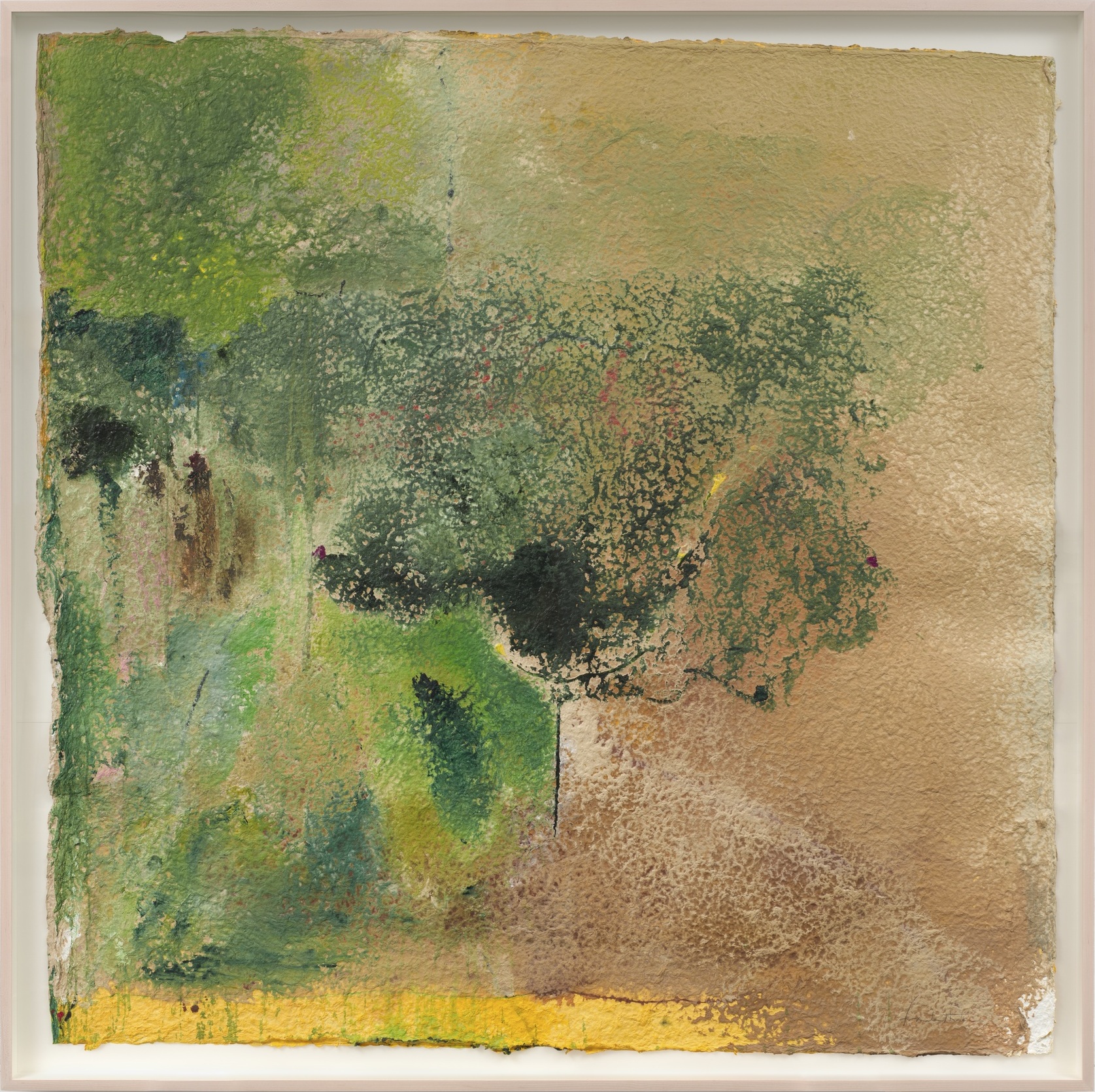
End of Summer, 1995
Currently exhibited: No
Material: acrylic on paper
Size: 199 x 199 cm
Inv-Nr.: B_611
Image rights: VG Bild-Kunst, Bonn; Copyright: Helen Frankenthaler Foundation, New York
Keywords:
Gagosian Gallery, New York, purchased in 2025
Helen Frankenthaler. Move and Make, 16.03.2025–28.09.2025
Frankenthaler appreciated the intimacy and immediacy of the paper medium. Its physical qualities—especially its ability to absorb pigment and allow it to bleed—suited her painterly approach. At the same time, paper offered a practical alternative to canvas: easier to handle, more flexible in application, and simpler to discard if necessary. As the physically demanding act of composing on the floor became increasingly strenuous, Frankenthaler shifted her compositions to large, sometimes hand-made sheets of paper, laid out on tabletops or sawhorses in her studio—a working method she had introduced as early as the 1960s, but which proved especially effective in her later years.
With its earthy tones and vivid greens, End of Summer (1995) evokes a sense of landscape. It is not only Frankenthaler’s largest single paper work, but also the most recent piece by the artist in the Reinhard Ernst Collection. A photograph shows Frankenthaler standing in front of the mounted work, adding final touches—deep in concentration. The image vividly conveys the physical closeness and direct engagement that characterized her late paper works.
John Elderfield, Frankenthaler, New York 1989, p. 284.
You are currently viewing a placeholder content from Hubspot Embedded Content. To access the actual content, click the button below. Please note that doing so will share data with third-party providers.
More InformationYou are currently viewing a placeholder content from HubSpot. To access the actual content, click the button below. Please note that doing so will share data with third-party providers.
More InformationYou are currently viewing a placeholder content from Hubspot Meetings. To access the actual content, click the button below. Please note that doing so will share data with third-party providers.
More Information