“What I want for my paintings is simply a spray of colour that hangs like a cloud, yet does not lose its form.” [1] Starting from this idea, Jules Olitski developed a new painting technique in the mid-1960s. He acquired a compressed-air spray gun and began no longer to apply paint, but to spray it into the air and onto the canvas.
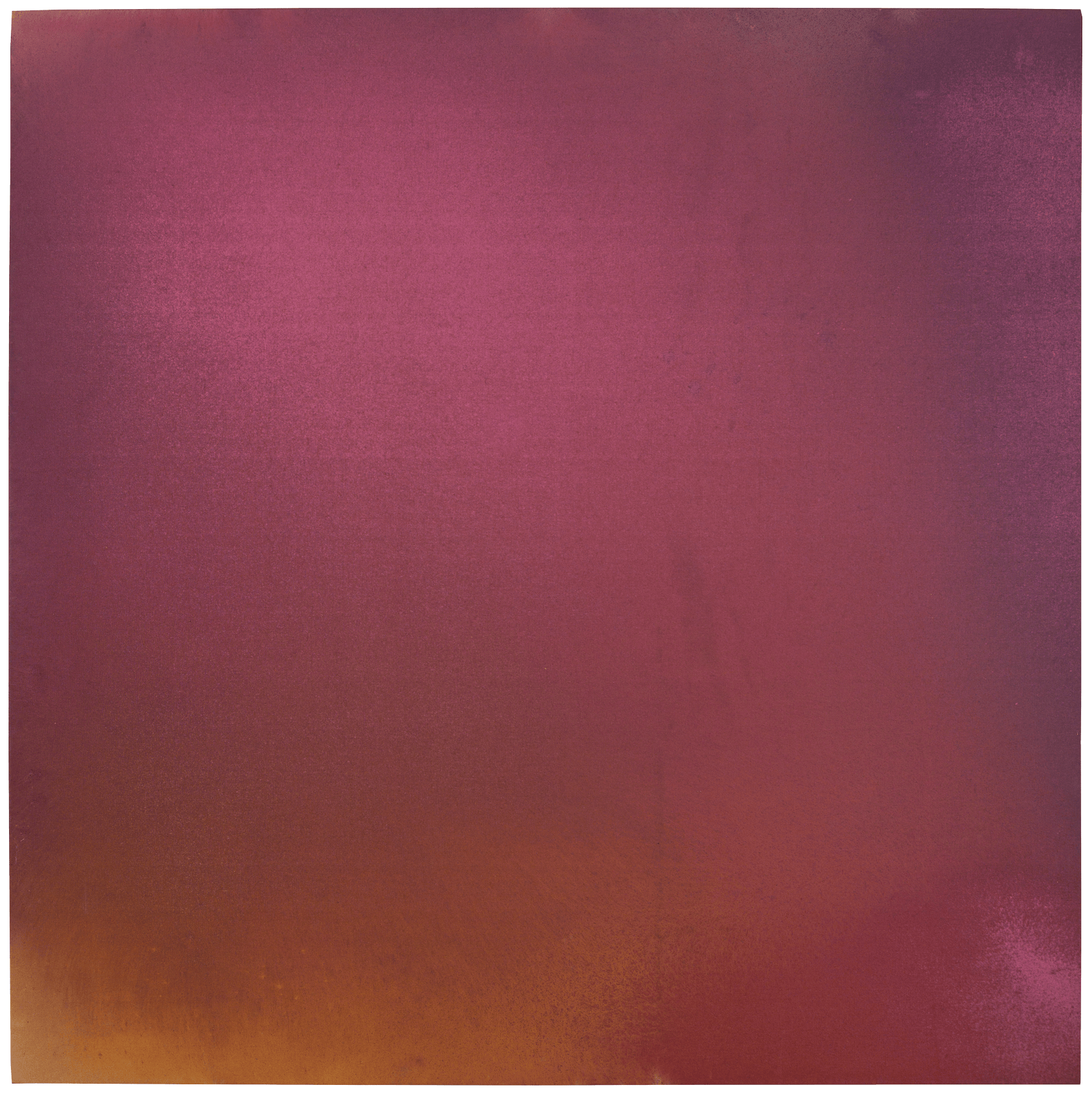
A coloured cloud of mist can be seen in Dolly Haze (1965), which marks the beginning of his spray paintings. The title itself already points to haze, mist and veils, elements that are central to Olitski’s new conception of painting. Colour no longer appears as a means of forming shapes; instead, it becomes the content itself. It lies on the canvas like a dense, vibrating veil, at once intense and permeable. Olitski described this aim as seeing colour “in and throughout, not solely on, the surface.” [2]
For his spray paintings, he placed the untreated canvas on the floor and colours of varying densities, before determining the final composition. Olitski deliberately dispensed with a visible hand, classical composition, symmetry or geometry. Clement Greenberg observed that the sprayed surfaces ‘[contrive] an illusion of depth that somehow extrudes all suggestions of depth back to the picture’s surface.’ [3]
In the late 1960s, Olitski exhibited internationally. In 1966, together with Helen Frankenthaler, Roy Lichtenstein and Ellsworth Kelly, he represented the United States at the Venice Biennale. In 1968, he participated in the 4th documenta in Kassel, and in 1969 the Metropolitan Museum of Art honoured him with his first solo exhibition for a living American artist. Works such as Dolly Haze exemplify his new approach: painting as a ‘flood of surface,’ a play with colour, light, and space that transforms the canvas into a vibrant, breathing presence.
Jules Olitski
Dolly Haze, 1965
Currently exhibited: Yes (Wolfgang Hollegha. Don't think, look!)
Material: Acrylic paint on canvas
Size: 173.5 x 169.5 cm
Inv-Nr.: B_209
Image rights: VG Bild-Kunst, Bonn
Keywords:
Acquisition: Reinhard Ernst Collection, Christie’s New York, 2011
Solothurn, Galerie Bernard, Amerikanische Malerei, Oct. 1964 – Febr. 1965, no. 42
[1] Jules Olitski: ‘How My Art Gets Made,’ Partisan Review 68, no. 4 (Fall 2001), pp. 617–623, here p. 617.
[2] Jules Olitski: ‘Painting in Color,’ United States of America, 33rd International Biennial Exhibition of Art, Venice, 1966, p. 39. Reprinted in Artforum, slightly revised, January 1967. Quoted in Kenworth Moffett: ‘Jules Olitski’s Sculpture’, in: Artforum, April 1969, Vol. 7, No. 8. Online: https://www.artforum.com/features/jules-olitskis-sculpture-210828/ (accessed 18 December 2025).
[3] Clement Greenberg: ‘Introduction to Jules Olitski at the Venice Biennale,’ in: Collected Essays and Criticism, ed. by John O’Brian, vol. 4: Modernism with a Vengeance, 1957–1969, Chicago 1995, p. 230.
You are currently viewing a placeholder content from Hubspot Embedded Content. To access the actual content, click the button below. Please note that doing so will share data with third-party providers.
More InformationYou are currently viewing a placeholder content from HubSpot. To access the actual content, click the button below. Please note that doing so will share data with third-party providers.
More InformationYou are currently viewing a placeholder content from Hubspot Meetings. To access the actual content, click the button below. Please note that doing so will share data with third-party providers.
More Information