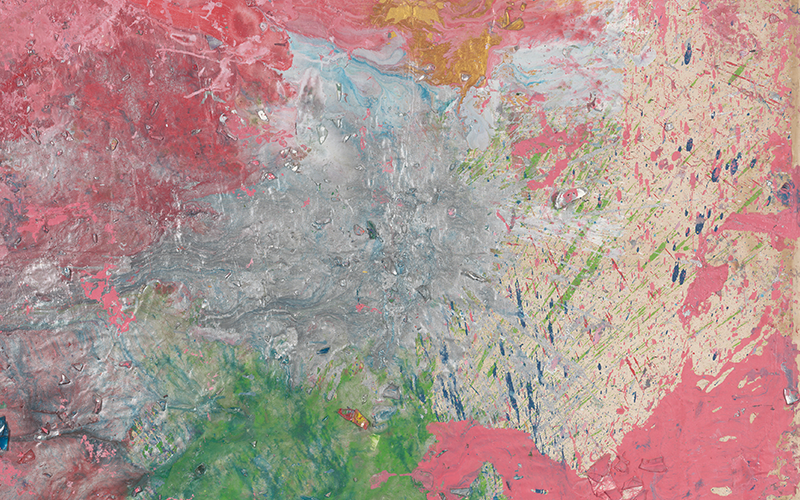
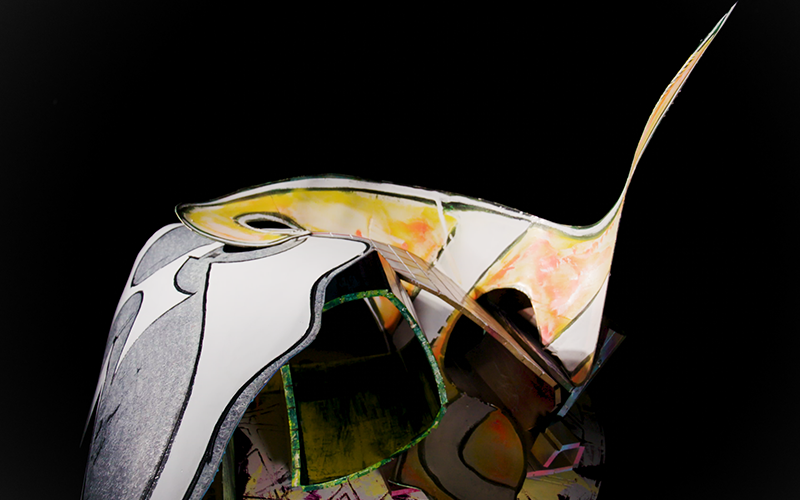
It is autumn. The woods surrounding Wiesbaden echo some of the hues in Hollegha’s Rindenschiff (Bark Boat) of 1983: mustard yellow, burgundy red, deep oranges against a crisp blue sky.
As the exhibition Don’t Think, Look! draws to a close at the end of October, I would like to reflect on the philosopher Ludwig Wittgenstein (1889–1951), whose work is quoted in the show’s title. Is it not somewhat a paradox that a philosopher tells us not to think? After all, is it not philosophy’s main concern to attain knowledge and wisdom through thinking?
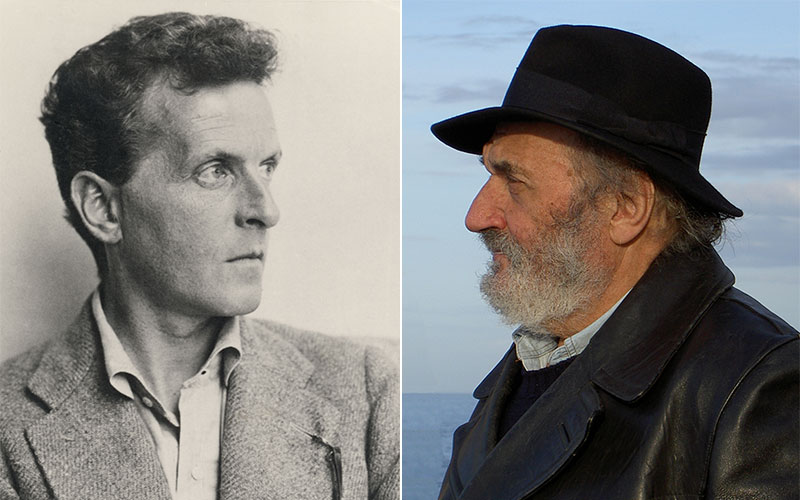
“Cogito, ergo sum” – I think, therefore I am, stated confidently René Descartes in the 17th Century [1], while David Hume, father of the empirical philosophy giving experience the upper hand over the rational world, would still ask a hundred years later: “Where am I, or what? From what causes do I derive my existence, and to what condition shall I return?”.[2] Thinking about thinking has been a human concern since we have been able to articulate language- the latter becoming a central focus in particular at the beginning of the 20th Century philosophy. Is language capable of describing every single idea we may have, can it grasp every thought or is it an intrinsically flawed and limited system?
These and similar questions entertained Ludwig Wittgenstein, a young Austrian engineer turned philosopher, who moved to England in order to study under the Cambridge professor Bertrand Russell, author of the Principles of Mathematics (1903). Wittgenstein was impressed by the ability of mathematics to convey ideas and truths through propositions. The structure that served mathematics here was logic, and Wittgenstein sought to apply these principles to understanding language and how we convey ideas. The philosopher came to the radical conclusion that language was incapable of articulating the answers to transcendental questions such as the purpose and meaning of our life. ‘There is indeed the inexpressible’ Wittgenstein would state in his Tractatus logico-philosophicus [3]. Interestingly, this quote gave title to Hollegha’s last monographic exhibition at the Joanneum in Graz in 2025. So how does a painter so concentrated on his immediate surroundings and the objects within it relate to a philosopher who sought to understand the structures that articulate our perception of the world?
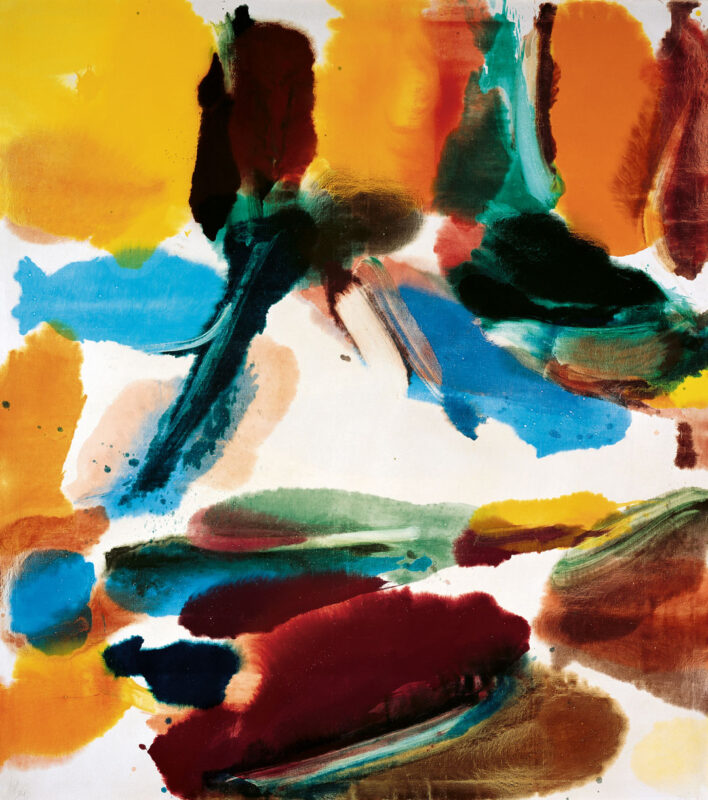
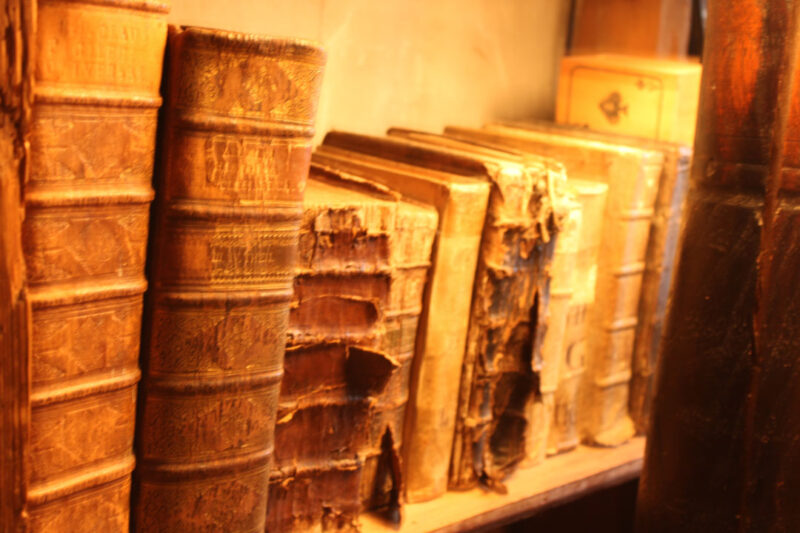
Hollegha was an avid reader of Wittgenstein’s work. Hollegha’s son Daniel recalls his father’s philosophy books to be completely worn out as if Hollegha intensely looked for answers for his own artistic quest in these texts. The artist approached reality through his senses, through intense observation before setting off to work, in order to translate the essence of the object into his own unique pictorial language. A language with colour as its structure and music at its heart.
After publishing his Tractatus, Wittgenstein thought he had solved the need for our pointless questing and kept quiet for decades. In his Philosophical Investigations, published posthumously in 1953, he pondered on the importance of meaning and its associations, and asked us to stop thinking and gain knowledge through our senses and intuition. [4] It is his “don’t think, look!” which gives title to this year’s monographic exhibition at the Museum Reinhard Ernst.
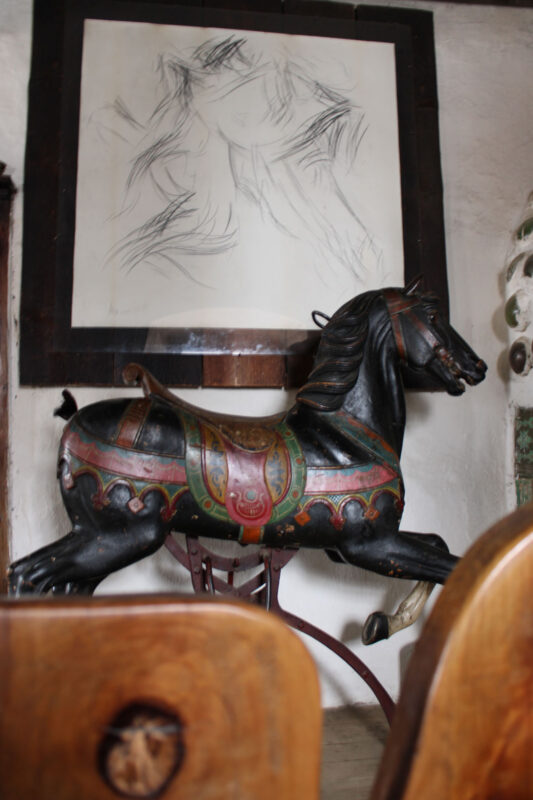
From the inexpressible of language to grasping meaning through our senses there is a leap of faith: we may be potentially clueless as to why we are here, after all, but perhaps there is no need to even ask that question in the first place, our head will not be the one to tell us but our senses will guide us to the answers we are looking for. And through these senses we get to experience how wonderfully different an ordinary object can be: all we need to do is look at it through Hollegha’s eyes.
If you haven’t been yet, do not miss this fantastic exhibition! Open until the 25th October. On the 25th itself you have the unique chance to view the documentary The Hero outside the Spotlight by Konrad Weixelbraun with the artist’s son. You can find out more about the programme and get your tickets here.
Text: Ines Gutierrez, Museum Reinhard Ernst
Proudly written without AI. With many thanks to Daniel Hollegha for his input and Kathrin Grün for translating the text into German.
Endnotes & further reading:
[1] Descartes, René, Discours de la Méthode, 1637. Online PDF available on https://philosophie.cegeptr.qc.ca p. 22 (last accessed 17.09.2026)
[2] Hume, David, An Enquiry Concerning Human Understanding, 1748. Online version available at https://davidhume.org/texts/t/1/4/7 T 1.4.7.8, SBN 268-9 (last accessed 17.09.2026)
[3] Wittgenstein, Ludwig, Tractatus logico-philosophicus, 1922. Online version available at https://wittgensteinproject.org/w/index.php/Tractatus_Logico-Philosophicus_(English) (last accessed 17.09.2026)
[4] Wittgenstein, Ludwig, Philosphische Untersuchungen, 1953, Online version available at https://www.wittgensteinproject.org/w/index.php/Philosophische_Untersuchungen ) (last accessed 17.09.2026)
For further reading on the artist, do get our exhibition catalogue!
You are currently viewing a placeholder content from Hubspot Embedded Content. To access the actual content, click the button below. Please note that doing so will share data with third-party providers.
More InformationYou are currently viewing a placeholder content from HubSpot. To access the actual content, click the button below. Please note that doing so will share data with third-party providers.
More InformationYou are currently viewing a placeholder content from Hubspot Meetings. To access the actual content, click the button below. Please note that doing so will share data with third-party providers.
More Information