Wolfgang Hollegha is counted among the most important Austrian painters after 1945. As early as 1960, he enjoyed considerable success in New York, where he maintained close exchanges with stars of American Modernism such as Morris Louis, Helen Frankenthaler, Kenneth Noland, and Jules Olitski. Despite this international recognition, he consciously withdrew to mount Rechberg near Graz.
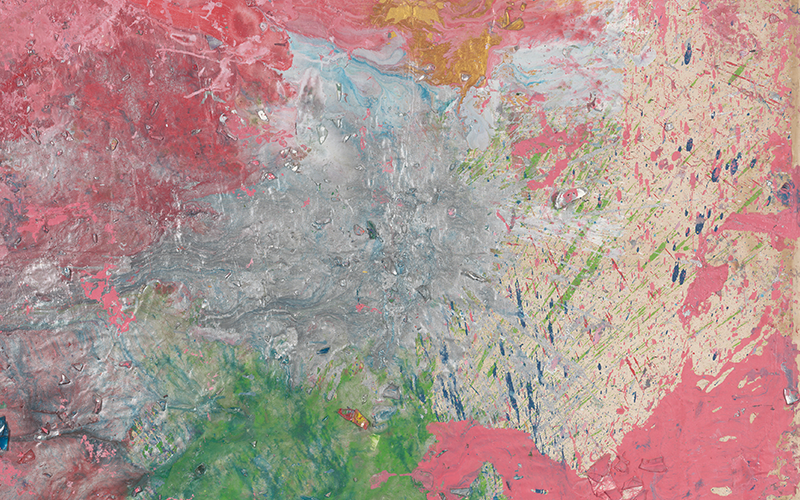
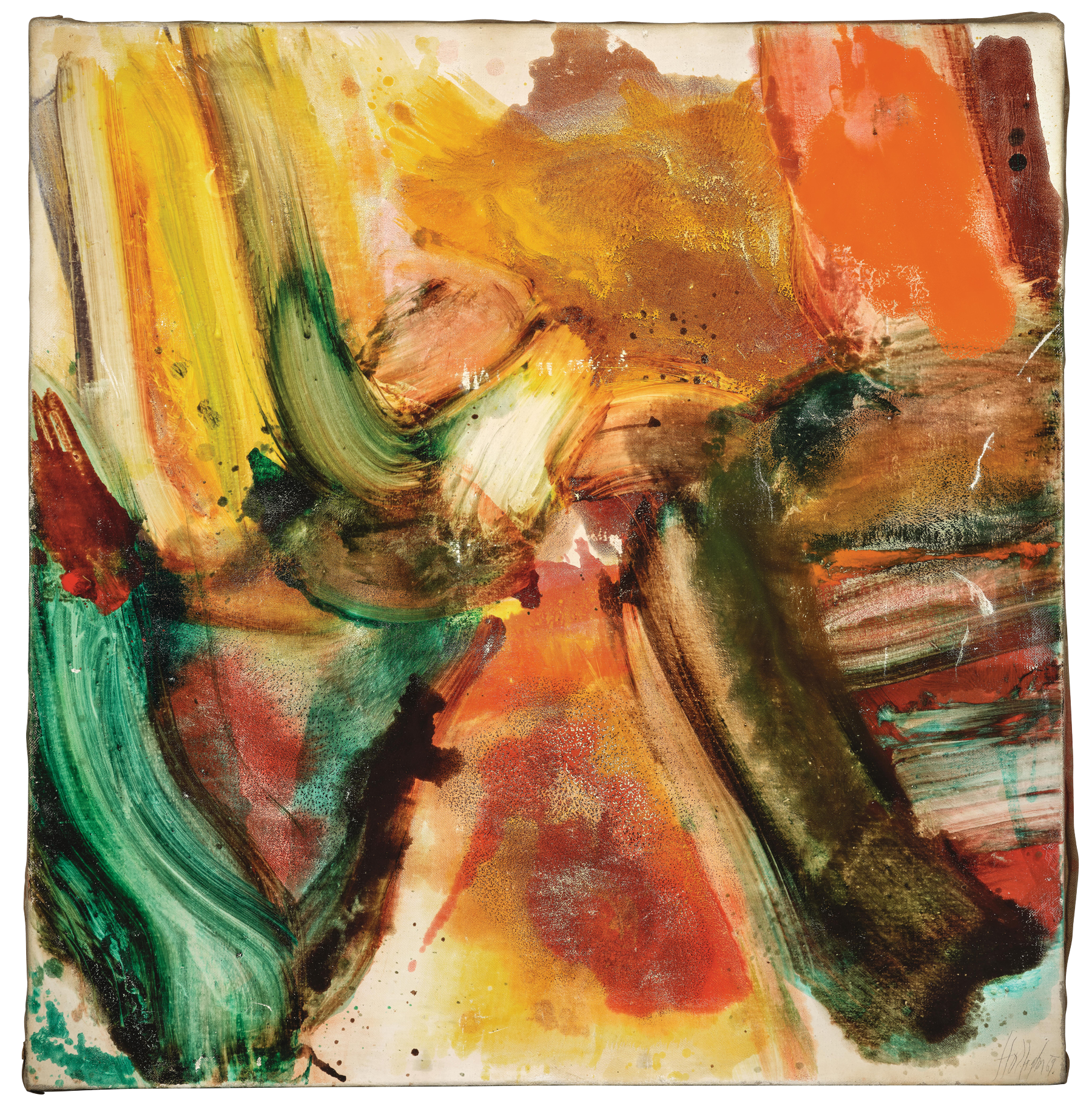
In the seclusion of the Styrian landscape, he developed an intense and independent painting practice over six decades, combining his very personal path to abstraction with the dynamism and movement of his American colleagues. Works such as Untitled (1969) from the collection exemplify this synthesis and reveal his artistic stance: in observing nature, the dialogue between figuration and abstraction begins for the painter. As he stated, ‘‘If I didn’t have the visible as a starting point, what I do would be purely arbitrary scribbling. I need the visible as a starting point in order to change it.’ [1] This approach forms the foundation of his work.
While the American art scene emphasised pure flatness, Hollegha’s paintings open up spaces in which the world of objects resonates in an abstract and highly subjective manner. Painting on canvases laid on the floor points to the influence of Abstract Expressionism, yet his adherence to the visible remains a deliberate counterpoint.
Wolfgang Hollegha
Untitled, 1969
Currently exhibited: Yes (Wolfgang Hollegha. Don't think, look!)
Material: Oil on canvas
Size: 120 x 118 cm
Inv-Nr.: B_653
Image rights: Wolfgang Hollegha Estate
Keywords:
Acquisition: Reinhard Ernst Collection, Sotheby’s New York, 2015
New York: Robert Elkon Gallery, ‘Dzubas: Recent Paintings’, 1961
[1] Antonia Hoerschelmann: ‘Abstraktion in Österreich 1945–1963. “Ein Zustand der Possibilität”’, in: The Beginning, Kunst in Österreich 1945 bis 1980, ed. by Klaus Albrecht Schröder, exhib. cat. Albertina Modern, Vienna 2020, pp. 107–133, here p. 123.