Larry Poons recalls that in 1969, following the opening of Jules Olitski’s exhibition of three-dimensional works at the Metropolitan Museum, he laid a canvas on the floor for the first time and began experimenting with paint. The resulting colour fields served as a precursor to his later Elephant Skin paintings and opened up new possibilities in his handling of materiality and surface.
During a visit by Clement Greenberg to his studio in 1971, the critic noticed how splatters were accumulating on a plastic sheet. He advised Poons to hang the canvas on the wall and fling the paint. This led to the first of his Throw Paintings, in which linear traces returned to the composition—traces common in traditional drawing, but which were considered obsolete in Pollock’s gestural, surface-encompassing technique.
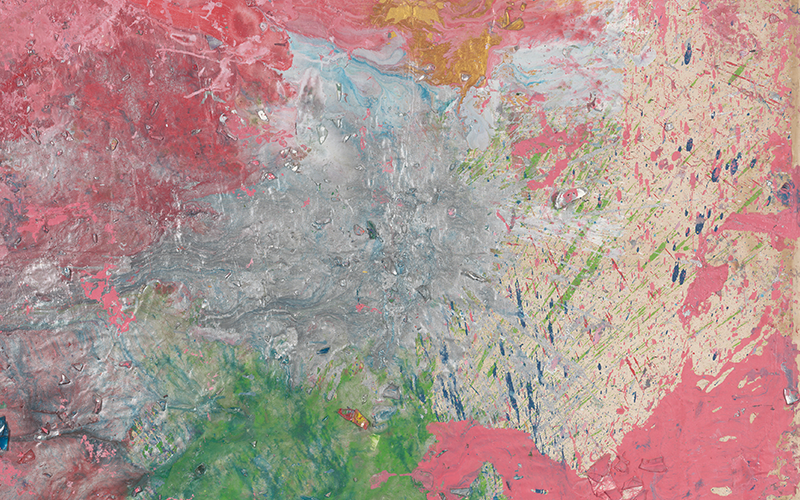
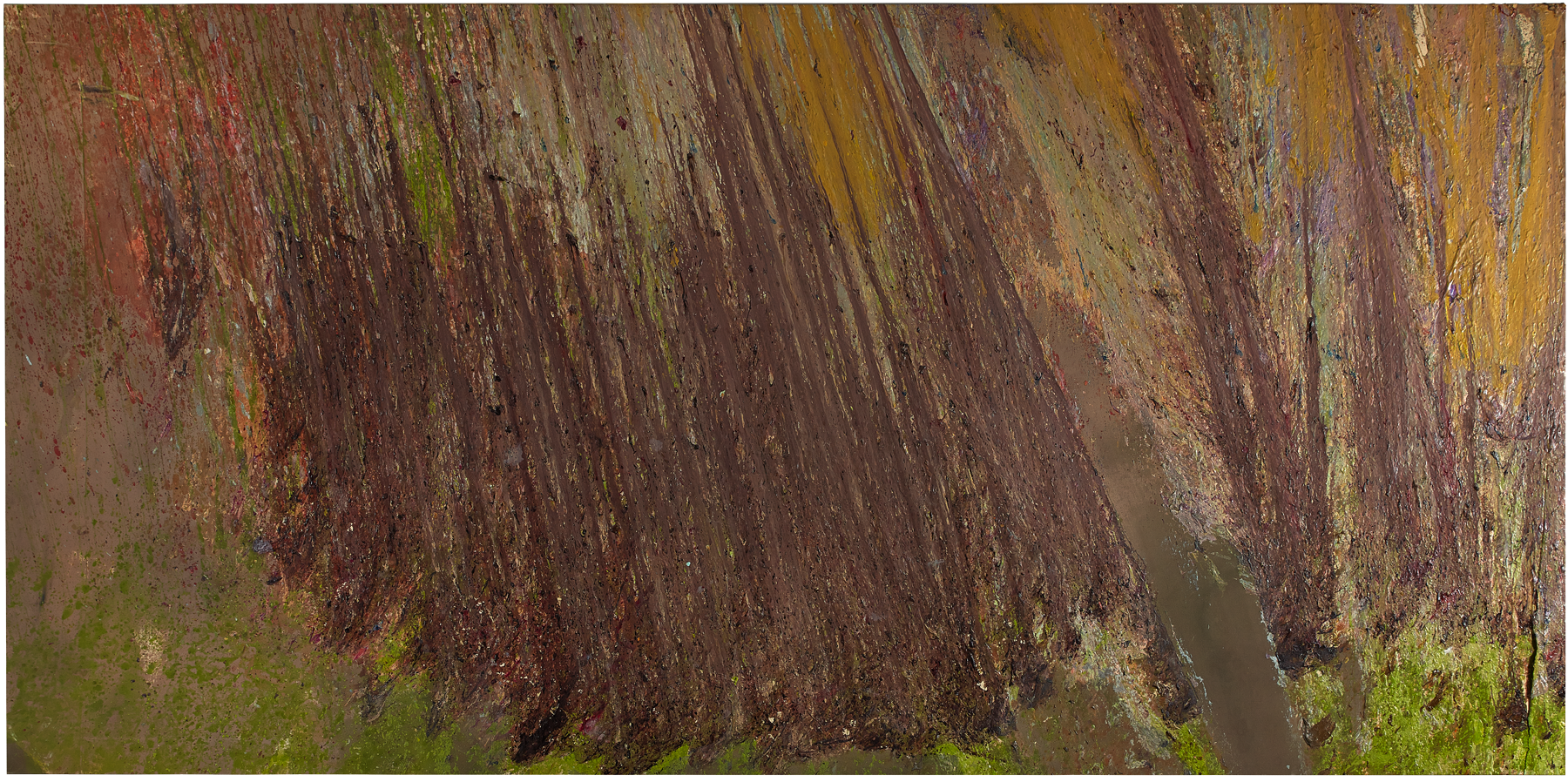
Initially, Poons would tint the fabric in a single colour before hurling volleys of paint onto the vertically hung canvas. Works such as Untitled #4 (1972) demonstrate how gravity and paint density dictate the movement of the medium. Drops run downwards, creep across the surface, or follow unpredictable paths when the canvas is rotated. Variations in falling speed and angle develop dynamic structures that place the flow of paint at the centre of attention. The Throw Paintings were not created through classical composition, but through discovery. As Poons himself observes: ‘A bucket is a brush […] painting has its own physics.’ [1]
With this technique, Poons builds on the paintings of Pollock, Frankenthaler, Noland, and Louis, developing their principles consistently further. His poured and thrown works are not regarded as a return to Abstract Expressionism, but as process-based painting that reasserts the relevance of this medium in the wake of Minimalism, Conceptual Art, and new artistic practices such as video and performance. The works combine physical gesture, the laws of physics, and experimental openness, situating Poons firmly within the expanded context of contemporary art.
Larry Poons
Untitled #4, 1972
Currently exhibited: Yes (Yes (Wolfgang Hollegha. Don't think, look!))
Material: Acrylic paint on canvas
Size: 181.7 x 368.2 cm
Inv-Nr.: B_223
Image rights: VG Bild-Kunst, Bonn
Keywords:
Sale: Waddington Galleries, London; Previous owner: unknown; Sale: Kasmin Gallery, London; Previous owner: unknown
Kunstmuseum Winterthur, Plane/Figure: Amerikanische Kunst aus Schweizer Privatsammlungen und aus dem Kunstmuseum Winterthur, p. 65 and 248, no. 65 (illustrated in colour)
[1] ‘In Conversation: Larry Poons with David Rhodes,’ The Brooklyn Rail, October 2017.